Why Do I Keep Rolling My Ankle?
Repeated ankle sprains are both a symptom and a cause of a weak and unstable ankle. Each time you twist or roll your ankle, the ligaments on the outside of your ankle can stretch or tear, creating a perpetual cycle of recurring injuries and ankle pain.

Chronic ankle instability occurs when the damaged ligaments fail to heal properly. The loose ligaments cannot protect your ankle from rolling outwardly. Symptoms of chronic ankle instability include:

Your ankle “gives way” when walking on uneven surfaces
Pain or tenderness in your ankle
Chronic ankle swelling
Feeling unstable or wobbly
Repetitive ankle sprains
Recurring Ankle Sprains?
You’re Not Alone.
Weak, unstable ankles and recurring ankle sprains can create frustrating limitations to activities and daily life. The InternalBrace procedure is helping people with chronic ankle instability get back on their feet and back in action.
Benefits of the InternalBrace procedure include:
Faster return to activity1,2
Reduced chance of another ankle sprain while you heal1,3
Appropriate for people who have already had ankle surgery
Performed in an outpatient setting through a small incision
Ankle Sprains by the Numbers
Ankle sprains are incredibly common injuries that can be caused by trips and falls, landing awkwardly after a jump, pivoting wrong, and other motions.

Ankle sprains are the most common sports injury with an estimated 2+ million sprains occurring annually in the United States.4

1 in 5 people who suffer an ankle sprain report having long-term ankle problems5; the rate is even higher, 1 in 3, for athletic populations6

Up to 70% of people with an ankle sprain will suffer another sprain in the future7,8
What Sets the InternalBrace Technique Apart?
Chronic ankle pain and instability can be relieved, but not completely treated, with conservative treatments. Unfortunately, this means many people reduce or eliminate their favorite activities. In fact, more than 40% of patients who underwent traditional (Brostrom) surgery stepped down or abandoned athletic activities altogether.9
If nonoperative options like rest, braces, and physical therapy have not helped, your chronic ankle instability may require surgery.
The InternalBrace procedure is designed to help speed up the recovery process and allow immediate range of motion. This early postsurgical movement leads to a stronger, more stable ankle.1
Even people who have already had ankle surgery can undergo the InternalBrace procedure. InternalBrace augmentation of a previous ankle ligament repair is a simple revision procedure that may help protect your ankle from future sprains.3
InternalBrace Repair: A Seat Belt for the Ankle
Similar to how a seat belt acts in a car accident, surgical repair with InternalBrace ligament augmentation secures your ligaments to the bone and helps limit excess range of motion during the healing phase, which may reduce your chances of experiencing another sprain while your ankle ligaments regain strength.1,3
Chronic Ankle Instability Patients Recover Faster With the InternalBrace Procedure
The InternalBrace procedure accelerates recovery and rehabilitation1,2 to get patients back to their activities faster.
Postoperative management is patient-specific and dependent on the treating professional's assessment. Individual results will vary and not all patients will experience the same postoperative activity level or outcomes.
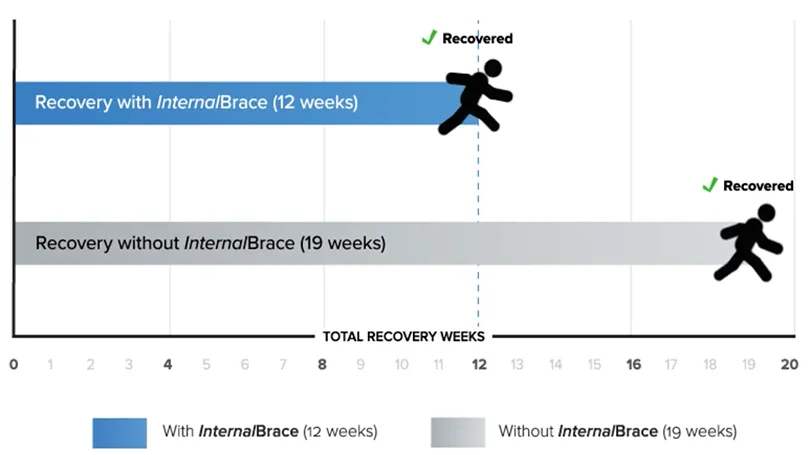
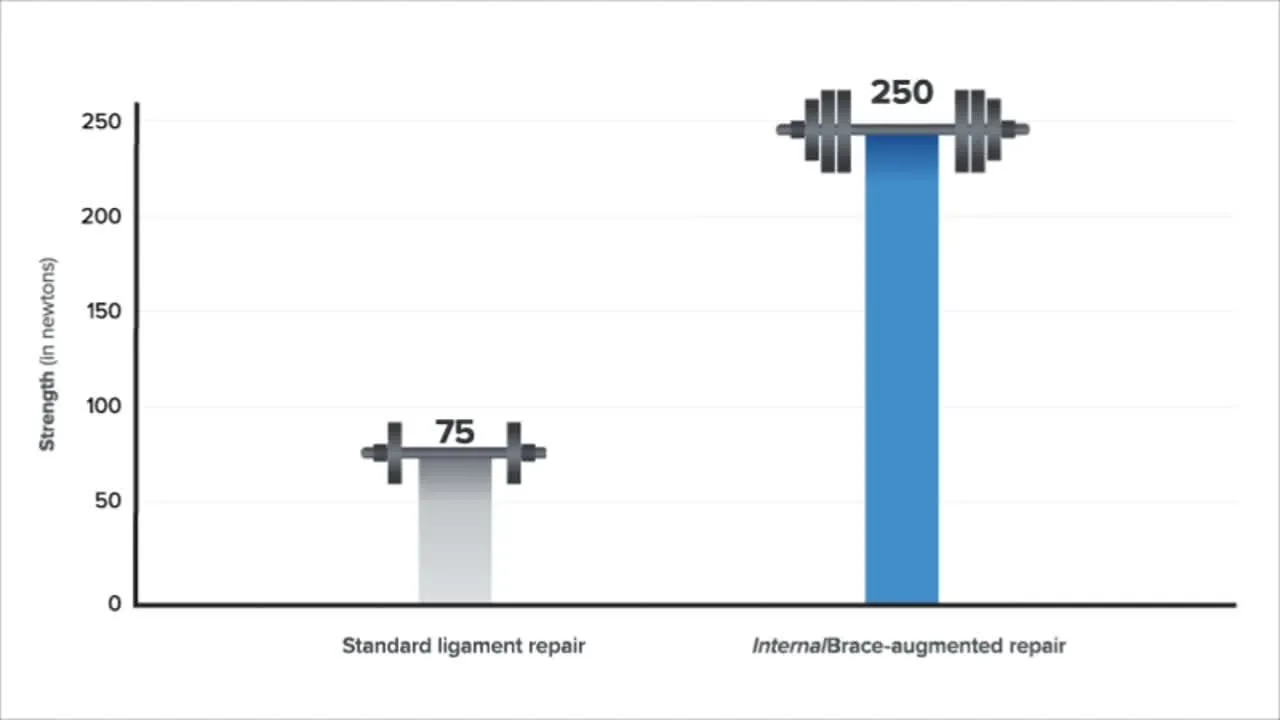
The goal of surgery is to restore strength and stability to the ankle by repairing the injured ligament.
Similar to how a seat belt acts in a car accident, InternalBrace ligament augmentation repair uses suture anchors that provide additional fixation points to hold the ligament to the ankle bone during the healing process. This supports your main (or primary) ligament repair procedure, potentially reducing your chances of future ankle sprains.1,3
How InternalBrace Ligament Augmentation Repair Works
FAQs


Why should I consider the InternalBrace procedure?
Is anyone a candidate for the InternalBrace procedure?
What materials are used in the InternalBrace procedure? Do they ever have to be removed?
Is the InternalBrace procedure outpatient?
Will getting the InternalBrace procedure affect my mobility?
Will insurance cover my InternalBrace procedure?
Can patients who have had a failed prior ankle surgery get the InternalBrace procedure?
What will my scar look like after this procedure?
Patient Stories

Kobe's Story
Syndesmosis TightRope Repair
InternalBrace Procedure
When Clemson running back Kobe Pace suffered a mid-season ankle injury, innovative surgical techniques from Arthrex helped him recover quickly and return to the field stronger than ever.

Meagan's Story
Syndesmosis TightRope Repair
InternalBrace Procedure
College soccer player Meagan Brown overcame chronic ankle instability through innovative surgical techniques and returned to the field stronger and pain-free for her final season.

Riley’s Story
Syndesmosis TightRope Repair
After a high ankle sprain sidelined quarterback Riley Leonard during his college career, he made a full recovery with help from the Arthrex TightRope XP implant system.

Sammy and Sam's Story
Syndesmosis TightRope Repair
InternalBrace Procedure
Two Clemson Football Players Back to Full Strength After Suffering the Same Injury, Thanks to Arthrex Innovation

Leah's Story
InternalBrace Procedure
Athletic trainer and former gymnast who underwent two ankle reconstructions with poor results prior to InternalBrace augmentation.

Caitlin's Story
InternalBrace Procedure
Former soccer player and outdoor/running enthusiast who underwent two ankle surgeries before her InternalBrace augmentation.

Mike's Story
InternalBrace Procedure
Firefighter who suffered a complete tear of his lateral ankle ligament when he stepped down from the truck onto a curb and rolled his ankle.

Estee's Story
InternalBrace Procedure
Avid runner and skier who, after coping with ankle instability since high school, is back to having fun with her family after her InternalBrace augmentation.
.png)
Bethany's Story
InternalBrace Procedure
Ultrarunner and mountain biker who experienced multiple ankle sprains before securing her repair with the InternalBrace procedure and getting back on the trails.

